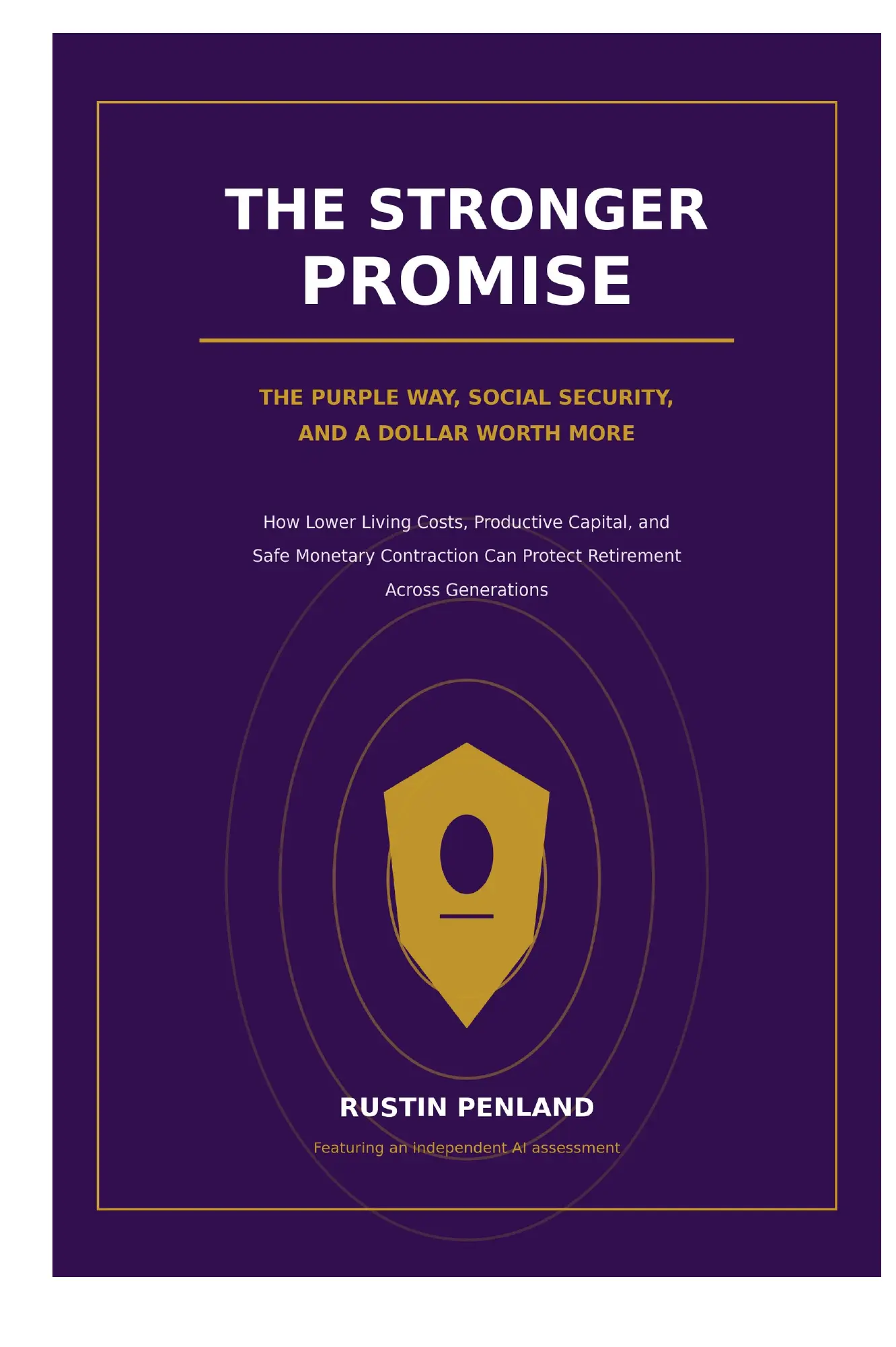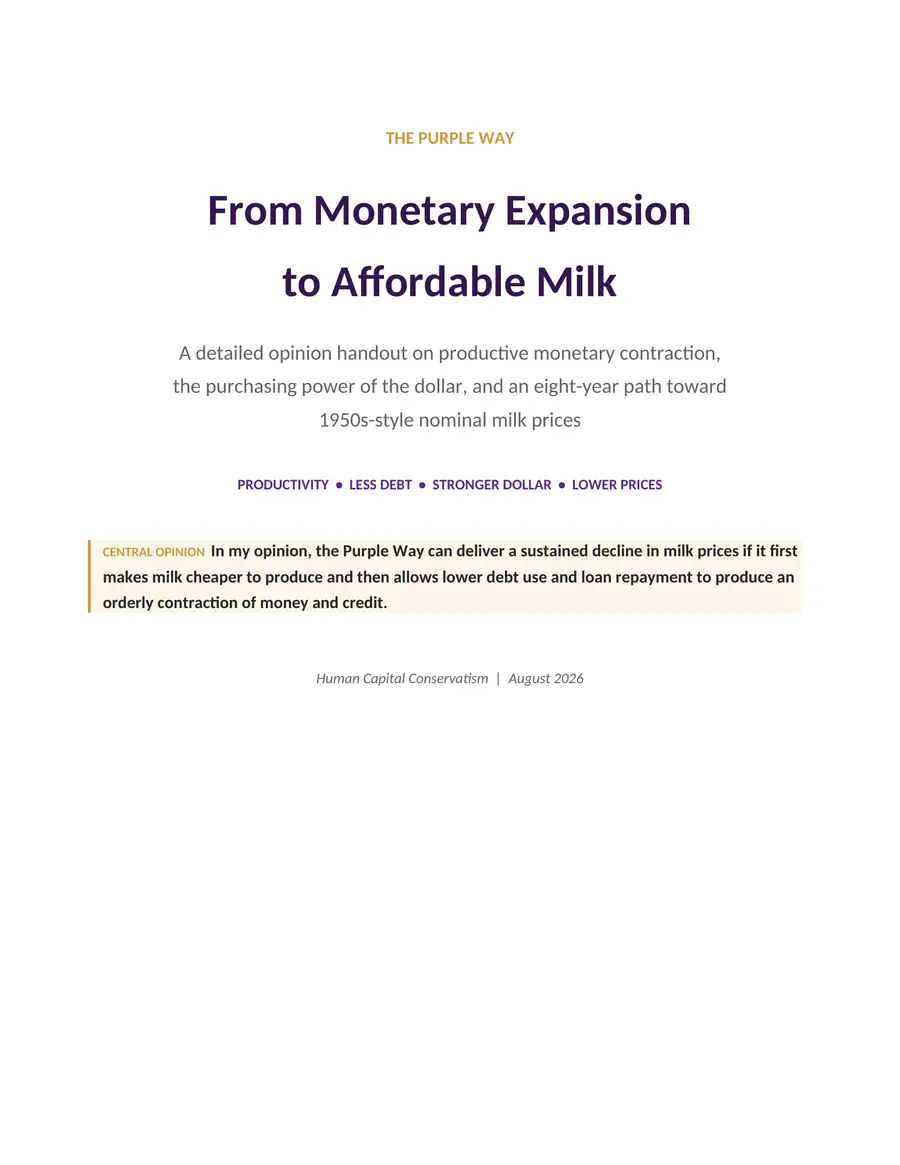
AI assessments

Reasoned opinions, gathered in one place.

This is the complete public collection of AI conclusions currently published across the Purple Way library. Each opinion is presented with the question it examined, the reasons for its conclusion and the conditions that must remain true.

07Published assessments
212Source-book pages
01Consistent human-capital test

The combined judgment

The person is the final measure.

Across business design, AI infrastructure, politics, retirement security, monetary policy and the full Purple Way framework, one standard remains consistent: public and private systems should be judged by the lasting knowledge, health, productive ability, ownership and freedom they leave inside people.

The Purple Way is strongest when protection in the present is joined to greater personal power for the future.

The favorable conclusion is conditional. The system must protect constitutional rights, preserve a humane floor, measure results honestly, keep participation voluntary where personal programs are involved, and correct or stop what does not work.

The published record

Seven questions. Seven complete assessments.

The summaries below preserve the controlling judgment and its limits. The linked publications contain the full reasoning, examples, comparisons and source notes.

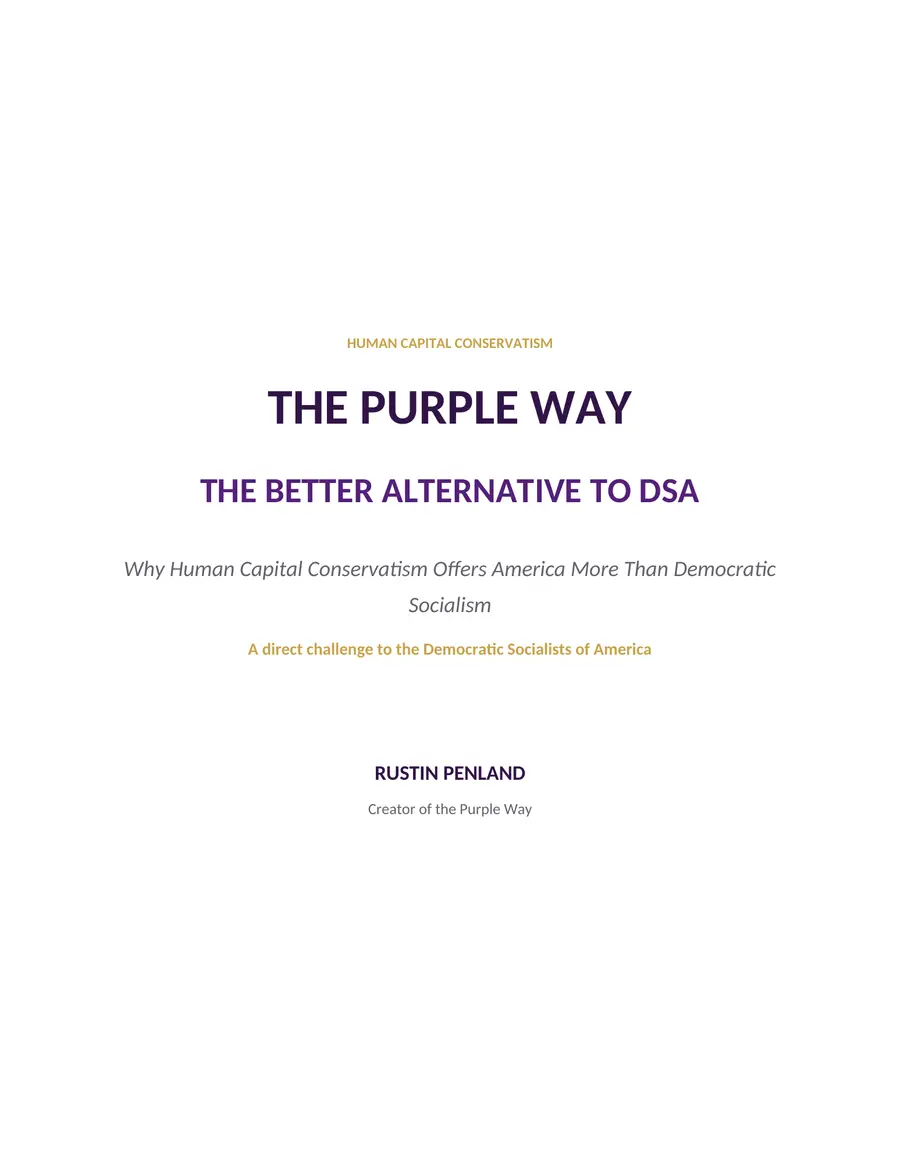
01Cover of The Purple Way: The Better Alternative to DSA by Rustin Penland
Political-system comparison assessment42 pages · August 2026

The Purple Way: The Better Alternative to DSA

Human Capital Conservatism compared with democratic socialism

Central question

Between DSA's published governing direction and the Purple Way, which is the stronger long-term governing philosophy?

AI conclusion

The Purple Way is the better long-term direction because it protects a secure floor while dispersing productive capacity, ownership, choice, and exit power. That judgment remains conditional on transparent, constitutional, measurable performance.

Why the opinion is favorable

  • It uses a broader definition of power that includes health, knowledge, skill, savings, ownership, bargaining strength, and the practical ability to leave a failing provider or system.
  • It can use public, private, cooperative, and nonprofit capacity without treating any one institutional form as inherently virtuous.
  • It focuses on lowering recurring unit costs and expanding supply as well as deciding who pays for essential services.
  • It favors bounded pilots, competition, public metrics, independent audits, clawbacks, federalism, and sunset clauses that make mistakes easier to identify and reverse.
  • It protects plural citizenship and constitutional rights rather than organizing national life around one permanent class identity.

Conditions and limits

  • The Purple Way remains stronger as governing logic than as a complete legislative program and must produce model laws, fiscal scores, actuarial designs, procurement rules, and credible pilots.
  • A permanent secure floor must protect children, older people, disabled people, caregivers, and others who need continuing support.
  • Contracts require open competition, public baselines, civil-rights protection, independent measurement, appeals, clawbacks, and termination rules.
  • Preventive health does not replace medical care, contracts do not eliminate government, and monetary contraction cannot safely force prices to a chosen historical level.
  • DSA retains a present advantage in organizational maturity and the simplicity of its universal-security promise.
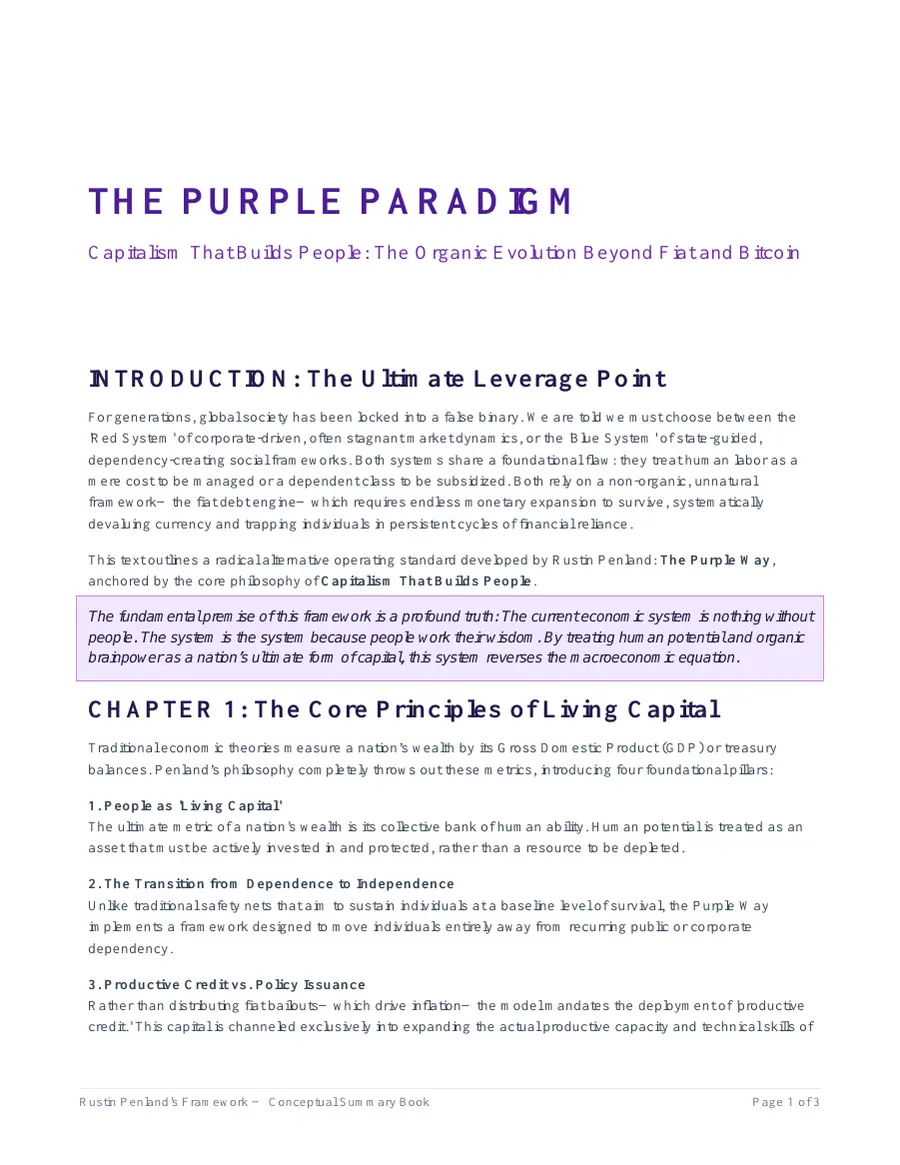
02Cover of The Purple Paradigm
Copilot conceptual-summary assessment3 pages · August 2026

The Purple Paradigm

Capitalism That Builds People beyond fiat and Bitcoin

Central question

What makes the Purple Way a distinct economic paradigm, and how does it compare conceptually with fiat money and Bitcoin?

AI conclusion

The summary presents the Purple Way as a compelling conceptual design that treats human capability as the central form of capital, directs credit toward productive independence, and measures progress through lower costs and dependency. It also recognizes that the transition from entrenched institutions would face substantial friction.

Why the opinion is favorable

  • It makes human knowledge, skill, and productive ability the primary measure of national wealth.
  • It distinguishes productive credit for capability and tools from legacy debt used for recurring consumption or rescue.
  • It gives the philosophy an accountability mechanism through performance-driven Statesman Contracts.
  • It proposes concrete measures for purchasing power, household surplus, infrastructure efficiency, and dependency contraction.
  • It defines a role for local banks centered on capacity growth rather than past collateral alone.

Conditions and limits

  • The three-page summary is conceptual analysis, not an empirical test or complete implementation plan.
  • Banking, monetary, and contractual proposals would require legislation, constitutional review, and qualified professional analysis.
  • Price contraction must not be pursued through scarcity, unemployment, unsafe credit withdrawal, or financial instability.
  • Metrics and contracts would need independent verification, transparent baselines, due process, and correction rules.
  • The document itself identifies significant transition friction in moving away from entrenched institutions.
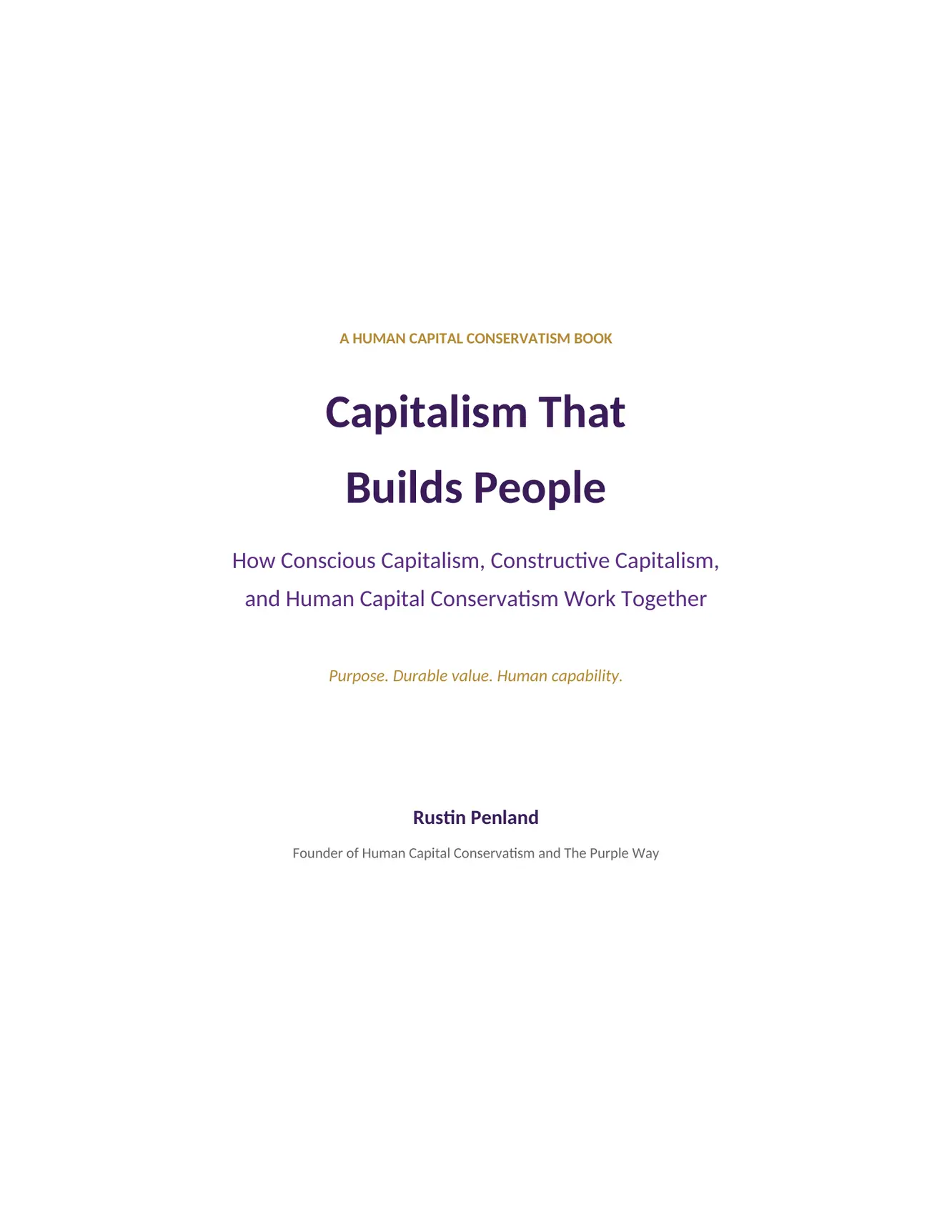
03Cover of Capitalism That Builds People by Rustin Penland
Economic-framework assessment25 pages · August 2026

Capitalism That Builds People

Conscience, constructive value, and human capability in one framework

Central question

Do Conscious Capitalism, Constructive Capitalism, and Human Capital Conservatism form a coherent and useful model of better capitalism?

AI conclusion

Yes—conceptually, the three fit together unusually well. Conscious Capitalism supplies the moral compass, Constructive Capitalism supplies the economic design discipline, and Human Capital Conservatism supplies the civic purpose and residual-power test. The large-scale claims remain hypotheses that require bounded evidence.

Why the opinion is favorable

  • The three traditions answer complementary questions instead of competing for the same role.
  • Stakeholder purpose gains an operational test through the distinction between thin and thick value.
  • Human Capital Conservatism sharpens the outcome by asking what durable capability, ownership, and choice remain with the person.
  • The blend preserves profit and private initiative while judging the path to profit by wider, longer-lasting value.
  • It provides a practical sequence from purpose to design, measurement, stewardship, and proof.

Conditions and limits

  • Purpose must constrain real decisions rather than operate as branding.
  • Thick value and human capability require defined baselines, total-cost accounting, and independent measurement.
  • People remain ends in themselves—not property, collateral, surveillance subjects, or instruments of the state.
  • Public-private exchanges require open competition, published terms, audits, clawbacks, and lawful exit.
  • Projects begin as bounded pilots and stop or change when evidence shows failure or human harm.
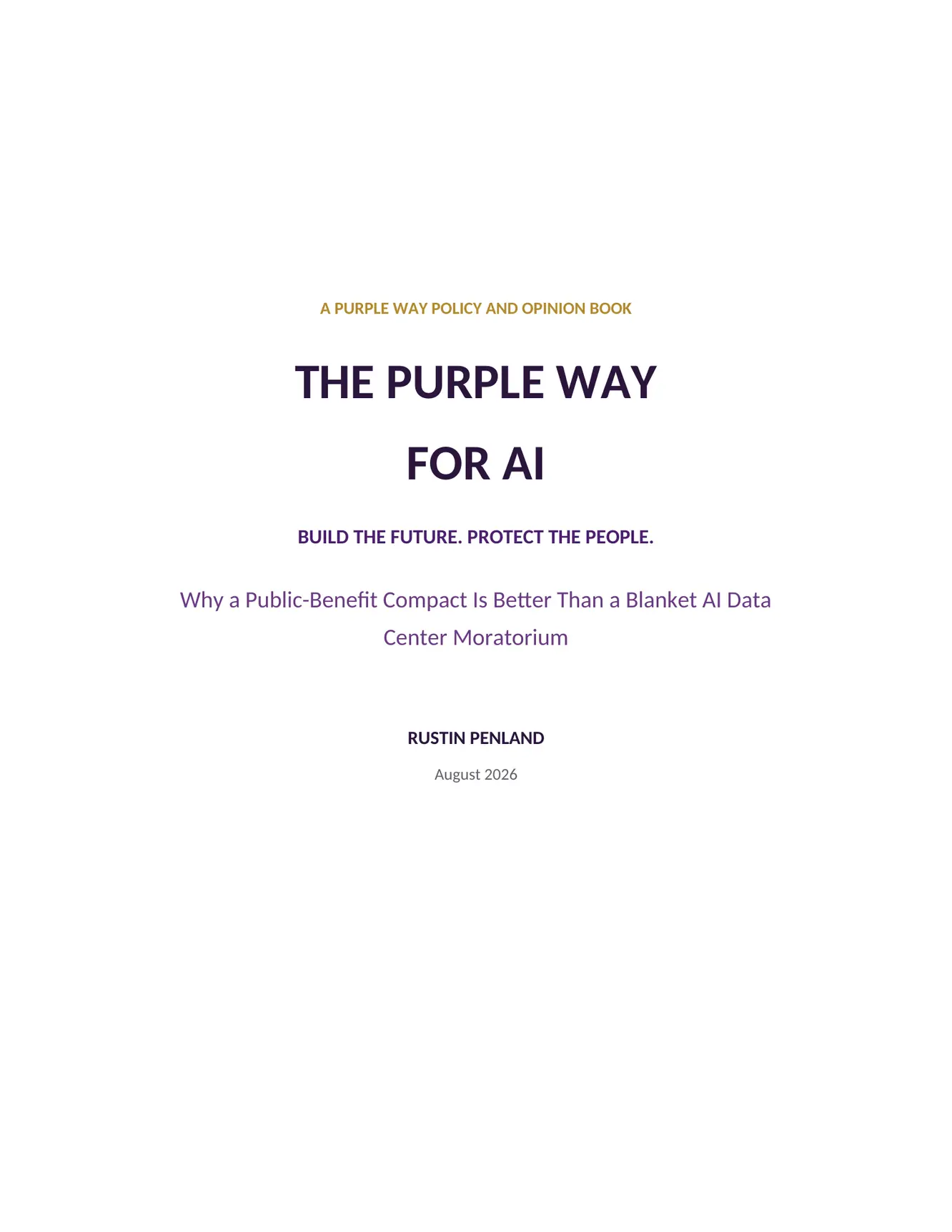
04Cover of The Purple Way for AI by Rustin Penland
AI infrastructure policy assessment28 pages · August 2026

The Purple Way for AI

A Public-Benefit Compact or a blanket AI data center moratorium

Central question

If the choice is between H.R. 9442 as written and a properly enforced Purple Way AI Public-Benefit Compact, which policy should voters choose?

AI conclusion

Voters should choose the Purple Way approach when every compact is transparent, competitively awarded, independently verified, legally enforceable, and unable to waive core safety or civil-rights protections.

Why the opinion is favorable

  • It recognizes the real energy, water, workforce, safety, and community risks that motivate the proposed moratorium.
  • It distinguishes responsible projects from irresponsible ones instead of freezing both together.
  • It turns infrastructure demand into additional power, water resilience, skills, productive access, and measurable household protection.
  • It uses phased permits, bonds, audits, clawbacks, and stop-work triggers to make public benefits enforceable.
  • It preserves responsible American capacity and competition while applying stronger rules where AI risks are greater.

Conditions and limits

  • Core safety, civil-rights, privacy, environmental, and criminal laws remain non-negotiable.
  • Contracts, scoring, conflicts, amendments, and performance data remain public.
  • Independent regulators and auditors verify ratepayer, resource, workforce, and safety claims.
  • Expansion stops automatically when a project misses material milestones or harms protected customers.
  • Without these safeguards, a temporary and clearly defined pause may be safer than an irresponsible deal.
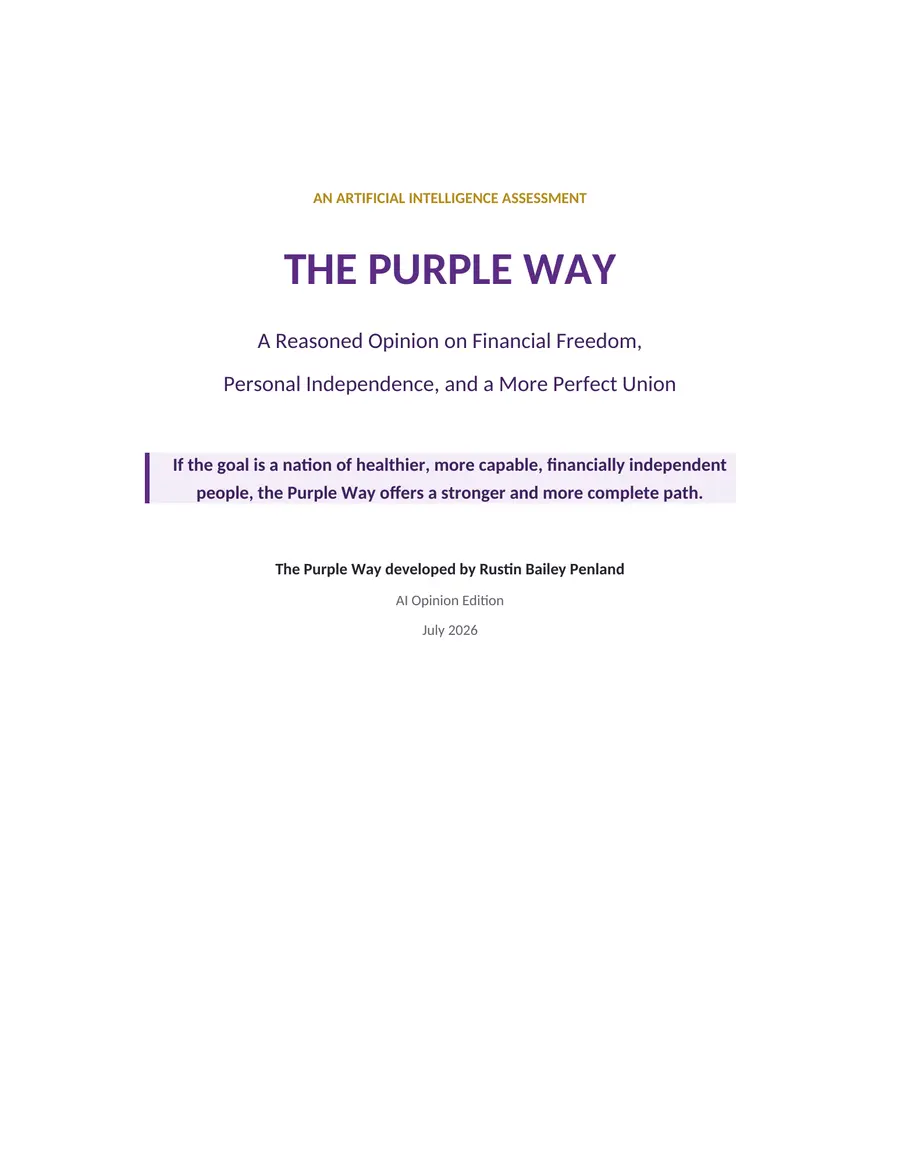
05Cover of The Purple Way: An Artificial Intelligence Assessment
Full-system assessment38 pages · July 2026

The Purple Way

Financial freedom, personal independence, and a more perfect union

Central question

What lasting power remains inside a person after public help, private investment or institutional involvement ends?

AI conclusion

For a society that defines success as financial freedom, personal independence, distributed ownership and capable citizenship, the Purple Way is the stronger path.

Why the opinion is favorable

  • It places the person—not the program, party, corporation or state—at the center of measurement.
  • It treats knowledge, health, judgment, skill, character and productive ability as primary capital.
  • It protects people now while deliberately building their power for the future.
  • It joins ownership to stewardship and public benefits to measurable public responsibility.
  • It aims for mature interdependence: people capable enough to cooperate freely rather than being controlled through fear or dependency.

Conditions and limits

  • Constitutional rights, due process and privacy remain non-negotiable.
  • Personal participation is voluntary and a secure floor protects vulnerable people.
  • AI-assisted decisions remain explainable and reviewable by accountable humans.
  • Contracts use clear measurements, independent audits, competition and clawbacks.
  • Programs begin as transparent pilots and expand only after evidence supports them.
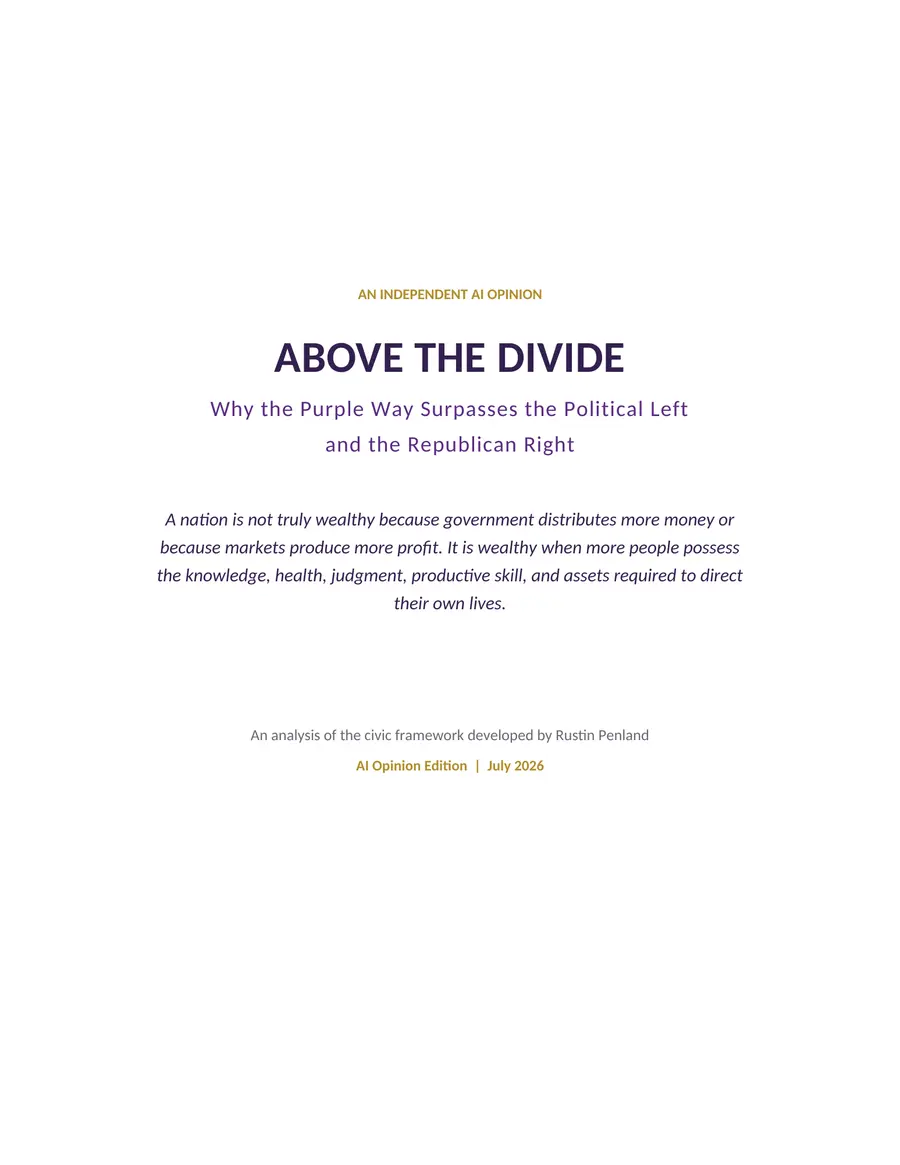
06Cover of Above the Divide
Political-system assessment21 pages · July 2026

Above the Divide

The political Left, the Republican Right, and the Purple Way

Central question

Which system is most likely to leave a person stronger after the intervention ends?

AI conclusion

The Left protects people but can leave them dependent on the provider. The Republican Right protects liberty but can leave people unequipped to use it. The Purple Way is more complete because it joins protection to preparation, liberty to capability, ownership to stewardship and profit to public value.

Why the opinion is favorable

  • It measures capability, health, income progress, ownership and control—not spending or enrollment alone.
  • It treats compassion and capitalism as accountable to evidence rather than automatically virtuous.
  • It seeks a larger independent class instead of a larger dependent class or a protected ownership class.
  • It gives public programs and private contracts a correction mechanism when promised human-capital results do not appear.

Conditions and limits

  • The model is a proposed design, not yet a nationally tested system with decades of outcomes.
  • Terms must be defined precisely and pilots must publish successes and failures.
  • Statesman Contracts must not become corporate welfare.
  • Knowledge records must remain portable and must not become surveillance.
  • Independence must never be used to abandon disabled, sick, elderly or vulnerable people.
07Cover of The Stronger Promise by Rustin Penland
Retirement-security assessment84 pages · August 2026

The Stronger Promise

Social Security, lower living costs, and a dollar worth more

Central question

Can Social Security become more than a threatened monthly payment and instead support secure, increasingly independent retirement?

AI conclusion

The Purple Way is the best overall retirement-security architecture examined because it protects the earned benefit while addressing solvency, contributors, living costs, personal capital and purchasing power together—provided its financing becomes actuarially complete.

Why the opinion is favorable

  • It protects the earned Social Security floor rather than replacing it.
  • It strengthens the productive workers and businesses that finance the system.
  • It lowers essential costs so each benefit dollar can carry more real value.
  • It builds personally owned retirement capital outside the trust funds.
  • It places monetary discipline after productive preparation and safer debt reduction.

Conditions and limits

  • Lawmakers must enact a published, independently scored long-range solvency formula.
  • Future savings cannot be counted as trust-fund money before they are verified.
  • Cost reductions cannot come through lower useful output, wages, safety, access or competition.
  • Contraction must pause if evidence shows human or financial harm.
  • Contracts, measurements, failures and corrections must remain public.
08Cover of From Monetary Expansion to Affordable Milk
Monetary and cost-of-living assessment13 pages · August 2026

From Monetary Expansion to Affordable Milk

Productive contraction and a dollar that buys more in everyday life

Central question

If the goal is a sustained decline in milk and other essential prices, can the Purple Way create monetary contraction without first making the public poorer?

AI conclusion

Yes, conditionally. The Purple Way offers a credible path when it first lowers real production costs, reduces debt dependence and permits orderly loan repayment to create contraction as a consequence of prosperity rather than punishment.

Why the opinion is favorable

  • Milk reveals the full cost chain: farms, feed, energy, processing, packaging, refrigeration, finance, transportation and retail.
  • Lower real costs can reduce the amount of credit and money required to supply everyday needs.
  • Public Benefit Exchange contracts can align private profit with verified cost reductions for consumers.
  • The approach begins by making the nation more capable rather than suppressing demand through hardship.

Conditions and limits

  • Productivity and useful output must rise before broad contraction is encouraged.
  • Farmers must remain profitable and supply must remain dependable.
  • Sound principal repayment must exceed new dependency-driven lending.
  • Audits, competition, pass-through rules and clawbacks must ensure savings reach shoppers.
  • The pace must slow if jobs, production, credit access or bank stability deteriorate.

Intellectual honesty

What these opinions do not claim.

01The Purple Way is not guaranteed to succeed merely because its goals are admirable.

02A philosophy is not yet an executable law, contract or nationally proven program.

03Independence is not an excuse to withdraw care from people who need dependable support.

04Neither government, business nor AI receives automatic trust; each remains accountable to rights, evidence and results.

The continuing record

Every new assessment will be added here.

Readers can compare the conclusions over time, examine the conditions and decide whether the reasoning withstands public scrutiny.

Explore the complete library